Mastering LED Selection: The Ultimate B2B Guide to Color Temperatures, Emitting Colors, and Light Source Types
A professional B2B guide to LED specifications. Master CCT, solid emitting colors, and light source types (SMD, COG, RGBW) to optimize your bulk procurement.
Navigating the technical specifications of LED procurement can be challenging for overseas wholesalers, engineering contractors, and cross-border e-commerce sellers. Choosing the wrong illumination profile can lead to project delays or high product return rates.
As a veteran LED engineering team with over 20 years of production and export experience, we have compiled this comprehensive, easy-to-understand technical guide. Master these three core elements—CCT (Color Temperature), Emitting Color, and Light Source Type—to ensure your next bulk order perfectly aligns with your market’s demands.
Part 1: Decoding Color Temperature (CCT) — The World of White Light
In the LED industry, Correlated Color Temperature (CCT) is measured in Kelvin (K). It exclusively describes the warmth or coolness of white light, tracking how a light source looks as it transitions from a warm golden hue to a crisp, icy blue.
1. Ultra Warm White / Amber (1800K–2200K)
- Engineering Description: This spectrum delivers a rich, vintage, candle-like golden glow. It completely eliminates harsh blue light waveforms, making it highly “dark-sky friendly” to protect nocturnal ecosystems.
- Best Applications: Ideal for traditional Edison filament bulbs and outdoor decorative solar string lines (like ST38 or S14). It is highly sought after by European and North American commercial buyers for patio hospitality, restaurants, and rustic landscape accenting.
2. Warm White (2700K–3000K)
- Engineering Description: The global standard for cozy ambient lighting. It radiates a soft, welcoming, and calming yellow-white tone that makes outdoor and indoor spaces feel inherently relaxing.
- Best Applications: Premium residential landscaping, architectural pathway lighting, hotel resort courtyards, and high-end lawn fixtures.
3. Natural White / Neutral White (4000K–4500K)
- Engineering Description: Formulated to replicate pure, mid-morning natural daylight. It sits perfectly balanced between warm yellow and cool blue, providing excellent contrast and high visual clarity without causing eye strain.
- Best Applications: The premier choice for modern B2B project contractors deploying intelligent LED strips in commercial offices, school classrooms, and high-end retail display showrooms.
4. Pure White / Daylight (5000K–5500K)
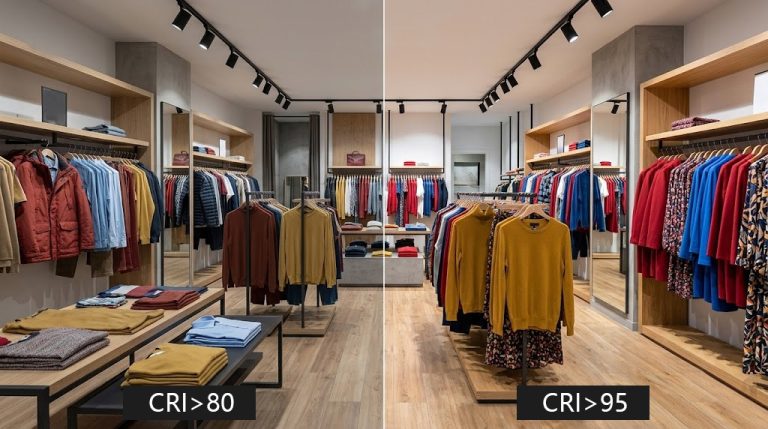
- Engineering Description: Mimics intensive, unfiltered noon sunlight. This spectrum offers an absolute neutral profile with zero color distortion, maximizing the Color Rendering Index (CRI) so objects appear in their true physical state.
- Best Applications: Highly requested by Amazon e-commerce brands for technical task lighting, art galleries, and high-efficiency horticulture plant growth lights.
5. Cool White (6000K–6500K)
- Engineering Description: A crisp, high-intensity white light characterized by subtle blue undertones. It triggers mental alertness and offers the highest possible visual contrast in dark environments.
- Best Applications: Industrial-grade fixtures such as commercial high bays, heavy-duty warehouse lighting, security parking lots, and outdoor municipal streetlights.
Part 2: Solid Emitting Colors — Visual Branding & Landscape Aesthetics
When a project demands vivid color saturation rather than white functional light, we transition to Monochromatic (Solid) Emitting Colors. Measured by physical wavelengths (nanometers/nm) rather than Kelvin, these colors define modern landscape and entertainment lighting.
1. Deep Red (620nm–630nm) & Royal Blue (460nm–470nm)
- Engineering Description: High-purity, solid color outputs. Red offers a commanding, high-visibility tone, while Royal Blue delivers a futuristic, deep-ocean aesthetic.
- Best Applications: Architectural facade outlining, gaming room smart strip kits, underwater pool fixtures, and specialized supplemental wavelengths for indoor farming.
2. Emerald Green (520nm–530nm)
- Engineering Description: A lush, organic, high-saturation green light that seamlessly interacts with chlorophyll wavelengths in flora.
- Best Applications: The absolute industry standard for landscape tree-uplighting, botanical gardens, and public park nighttime illumination.
3. Vibrant Pink / Purple
- Engineering Description: A trendy, neon-like, ultra-saturated romantic tone that commands immediate consumer attention.
- Best Applications: Consistently sourced by cross-border e-commerce retail brands for atmospheric bar signage, bedroom ambient strips, and holiday event decorations.
Part 3: LED Light Source Types — From Cost-Efficiency to Smart Evolution
The structural design of the LED chip itself dictates how light is dispersed, how heat is managed, and how smart control protocols are executed.
1. Mid-Power SMD (e.g., SMD 5730 / SMD 2835)
- Engineering Description: Surface Mounted Device (SMD) chips are soldered flat onto circuit boards. Premium SMD 5730 features an enlarged luminous surface and an integrated thermal pad on the bottom. It offers an exceptional balance of high current tolerance, low lumen degradation, and extreme cost-efficiency.
- Best Applications: High-output functional rigid light bars, commercial floodlights, and mass-market lawn fixtures.
2. COG (Chip on Glass) Filament Technology
- Engineering Description: An elite engineering breakthrough where micro-LED chips are linearly packaged directly onto a transparent glass (or sapphire) substrate and sealed with premium phosphor silicone. Because the base is transparent, it achieves an unobstructed 360° omnidirectional glow, completely eliminating the 180° dark zones of traditional flat SMD chips.
- Best Applications: High-end retro Edison filament bulbs and premium low-voltage/solar-powered decorative string lights.
3. Smart Dynamic Lights: RGB vs. RGBW vs. RGB+CCT
- Engineering Description:
- RGB: Blends Red, Green, and Blue diodes to create millions of color variants, but cannot produce a high-quality, crisp white light.
- RGBW: Adds a dedicated, independent white diode into the architecture, allowing seamless shifting between vibrant party colors and crisp, functional white illumination.
- RGB+CCT: The ultimate smart configuration, offering millions of colors plus a fully adjustable white spectrum ranging from 2700K to 6500K.
- Best Applications: Intelligent home strip kits, architectural ambient systems, and app-controlled holiday lighting.
4. Addressable RGB / Magic RGB (Built-in IC)
- Engineering Description: These strips feature integrated circuit (IC) microchips (such as WS2811 or WS2812B) embedded directly into the circuit line. This allows individual control over every single LED node, unlocking advanced dynamic motion effects like chasing waves, flowing water, and rainbow cascades.
- Best Applications: High-margin e-commerce tech gadgets, modern gaming setup aesthetics, and dynamic commercial signage.
Partner with an Experienced Industry Leader
Maximize Wholesale Margins with Stable & Flexible LED Supply

- Diverse Product Sourcing: Maximize your wholesale margins with our factory-direct, comprehensive product range—from outdoor lawn lights and commercial high bays to flexible light strips—all integrated under one reliable supplier.
- Flexible OEM/ODM & Packaging: Full support for volume buyers with custom branding, white-label options, tailored retail packaging design, and flexible MOQ requirements.
- Consistent Bulk Quality & Stability: Strict, multi-stage quality control ensures that your volume orders perfectly match the approved samples, protecting your local brand reputation and minimizing costly returns.